Agency Playbook: Pitch and Retain Clients with Transparent Ad Research
Clients don’t fire agencies because campaigns never change—they fire agencies because the changes aren’t explained. Transparent ad research fixes that.
In this playbook, you’ll learn a practical agency research workflow anchored in the Meta Ad Library, how to stay safe and ethical, and how to turn findings into a client-ready deliverable that proves value in every pitch, QBR, and renewal.
You’ll also see where a centralized workspace like Insights for agencies fits so your team stops losing context in slides and screenshots.
Why Transparency Wins Pitches—and Keeps Retainers
Procurement wants proof, CMOs want clarity, and founders want speed. Transparency satisfies all three. When you show exactly how the market advertises, what angles scale, and which products are accelerating, you shift the conversation from opinions to evidence.
The result: stronger positioning in pitch rooms, better budget defense in QBRs, and a calmer day-to-day because stakeholders understand the why behind creative and media decisions.
What “Transparent Ad Research” Actually Means
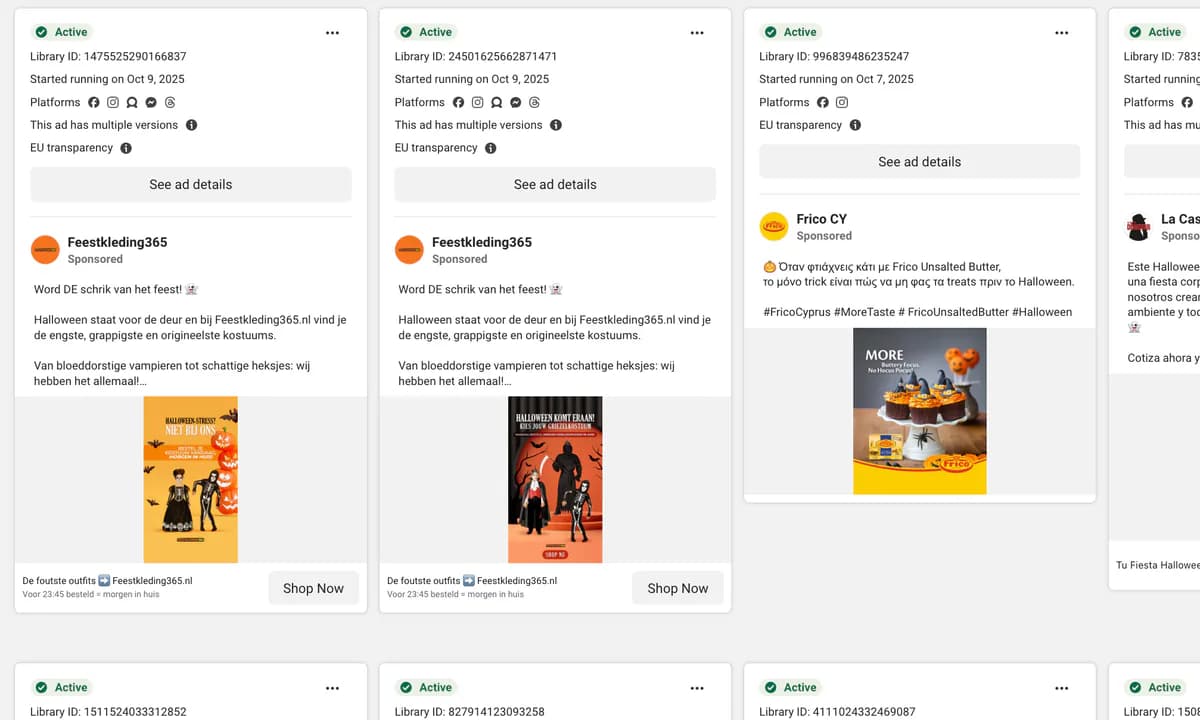
The Meta Ad Library is a transparency portal. You can see live ads, creative families, and—in some categories—archived items. It is not a performance dashboard for commercial ads (you won’t see spend or ROAS).
That’s fine: agencies can still build a reliable picture from proxies such as longevity (how long an ad runs), iteration (the pace of new variants), format/placement mix (Reels, Stories, Feed), and geographic spread. Document those signals with examples and dates and you have a repeatable, honest evidence trail—ideal for competitive analysis for clients.
Ethical Guardrails (Safe Research, Happy Lawyers)
- Use transparency tools as intended. Don’t scrape personal data or bypass rate limits.
- Borrow principles, not IP. Extract hooks, structures, and formats—avoid cloning brand assets or trademarks.
- Document sources and dates. Keep claims auditable with advertiser names, links, and timestamps.
- Flag risks early. Over-claims, missing disclosures, or look-alike branding are red flags to avoid.
Agency Research Workflow (Client-Ready, Time-Bound)
- Define the question: validate a product, map competitors, or refresh creative angles. Time-box each cycle (60–90 minutes).
- Build seed queries: combine product keywords, pain/benefit phrasing, brands, and common typos (plural/singular).
- Search & scan: check ad start dates, active status, volume of variants, format mix, and geos. Capture examples.
- Score proxies: rate longevity, iteration, and breadth (0–2 each). Shortlist items scoring ≥4/6.
- Extract patterns: recurring hooks; proof types (UGC/testimonials/before-after); offer structures (anchors, bundles, scarcity).
- Draft actions: translate evidence into 3–5 creative tests and 1–2 audience/geo hypotheses.
- Package deliverable: one page with executive summary, evidence gallery, recommended tests, risks, and next steps.
- Centralize: save links, screenshots, and notes in one system so re-analysis doesn’t start from zero.
Your Client-Ready Deliverable (1-Page Template)
- Executive Summary: 4–6 sentences tying problems to recommended actions.
- Evidence Gallery: 6–10 annotated creatives (thumbnails + notes).
- Signals Table: longevity, iteration, breadth, and key hooks per example.
- Recommendations: creative tests, offers, and geo/placement priorities.
- Risks & Guardrails: compliance checks and what not to emulate.
- Measurement Plan: KPIs and timing for the next sprint.
----------------------
----------------------
Comparison: Old Way vs. Transparent Way
| Old Way | Transparent Way |
|---|---|
| Decks full of opinions | Evidence-led narrative tied to public libraries |
| One viral example | Patterns across time, geos, and formats |
| Copycat creative | Principle-driven hooks and brand-safe structures |
| Lost screenshots | Centralized links, notes, and re-analysis |
| Defensive QBRs | Calm QBRs with a clear why behind decisions |
Data Storytelling Framework (Make the Evidence Memorable)
Clients remember stories, not spreadsheets. Use a simple flow: Context → Evidence → Action → Outcome. Start with the market problem you’re solving, show a small gallery of evidence (creative families and their signals), translate it into 3–5 concrete tests, and close with how success will be measured. Keep screenshots annotated, captions short, and recommendations prioritized.
Signals Scoring: A Lightweight Rubric
Assign 0–2 for each dimension and sum to a 6-point score:
- Longevity (0–2): 0 = days; 1 = 1–2 weeks; 2 = multi-week persistence with refreshes.
- Iteration (0–2): 0 = few/no variants; 1 = several; 2 = systematic testing cadence.
- Breadth (0–2): 0 = single geo/format; 1 = some variety; 2 = multi-market and multi-format mix.
Shortlist items scoring ≥4/6, then craft tests from the common hooks and offers.
QBR Slide Outline (Ready-to-Use)
- Slide 1: Executive Summary (three bullets, one chart).
- Slide 2: Signals at a Glance (table: longevity, iteration, breadth).
- Slide 3: Evidence Gallery (6–8 thumbnails with captions).
- Slide 4: Recommended Tests (ranked backlog with expected learning).
- Slide 5: Risks & Guardrails (compliance and brand notes).
- Slide 6: Measurement Plan (KPIs, timing, owners).
Operationalizing Transparency Across the Agency
Transparency isn’t a deck; it’s a habit. Bake it into rituals:
- Weekly evidence stand-ups: 15 minutes to review new patterns and retire stale ones.
- Shared template library: keep one-page deliverables and annotated examples for reuse.
- Single source of truth: centralize links and notes so anyone can re-analyze without hunting files.
Where Insights Fits (Single Source of Truth)
Transparent research only sticks if it’s centralized. With Insights for agencies, your team pastes a product URL and stores structured findings—ad reach indicators, creative inventory, trend direction, and competitor visibility—so you can revisit and update evidence without rebuilding decks. It becomes the hub for ad research deliverables and collaboration across accounts.
Implementation: A 30/60/90-Day Agency Plan
- Day 0–30: standardize the 1-page deliverable and train the team on safe research. Pilot on two accounts.
- Day 31–60: roll out to all retainers. Add a “Transparency Section” to QBRs. Track time saved per research cycle.
- Day 61–90: integrate into new-business pitches. Build an anonymized gallery of examples for sales enablement.
----------------------
----------------------
Objections & Responses (Use in Pitches)
- “No spend/ROAS in the Library, so what’s the point?” We use proxies (longevity, iteration, breadth) to identify probable winners, then validate via controlled tests.
- “Isn’t this just copying?” No—our approach extracts principles (hooks, structures, proof) and rebuilds in your brand voice with compliant claims.
- “Will this add overhead?” The standardized 1-pager replaces ad-hoc research; it actually reduces meeting time and speeds decisions.
Common Pitfalls (and Quick Fixes)
- Cherry-picking a single viral ad: require at least two persistence signals before recommending a test.
- Copying creative 1:1: abstract the principle, then rebuild for brand fit and compliance.
- Confusing noise with scale: seek multi-market rollouts, broader format mix, and consistent messaging.
- Losing your notes: standardize the template and centralize it so the team can revisit quickly.
FAQs (Short & Practical)
Does the Meta Ad Library show spend or ROAS?
No. Use proxies—longevity, iteration, placement/geo breadth—then test. Tie proxies to next steps in your deliverable.
Is cloning competitor ads safe?
No. Extract principles (hook, structure, proof) and rebuild in your brand language with compliant claims.
How often should we refresh research?
Weekly during heavy testing; bi-weekly for steady accounts; always pre-pitch and pre-QBR for storytelling.
Where do we keep the research?
Centralize it so analysis is repeatable across clients and sprints. Link evidence directly in your deliverable.
Resources & Links
Questions about coverage, methodology, or plan limits? See the FAQ. Need a quick overview of plans? Check Pricing. Prefer a walkthrough first? Watch the Live Demo. Want a lightweight trial run? Try the Free Live Test.
----------------------
----------------------
Free Trial: How to Sign Up for Insights - Powered by Trampolin.ai
Getting started is fast: create your account, paste your first product URL, and review your dashboard in minutes. Our 14-Day Free Trial is no credit card required—explore features, save analyses, and upgrade only if it fits your workflow. When you’re ready, use the signup page to begin.