From Curiosity to Cart│Interpreting Meta Ad Library Signals Without Performance Data
Why the Meta Ad Library still matters (even without CTR/ROAS)
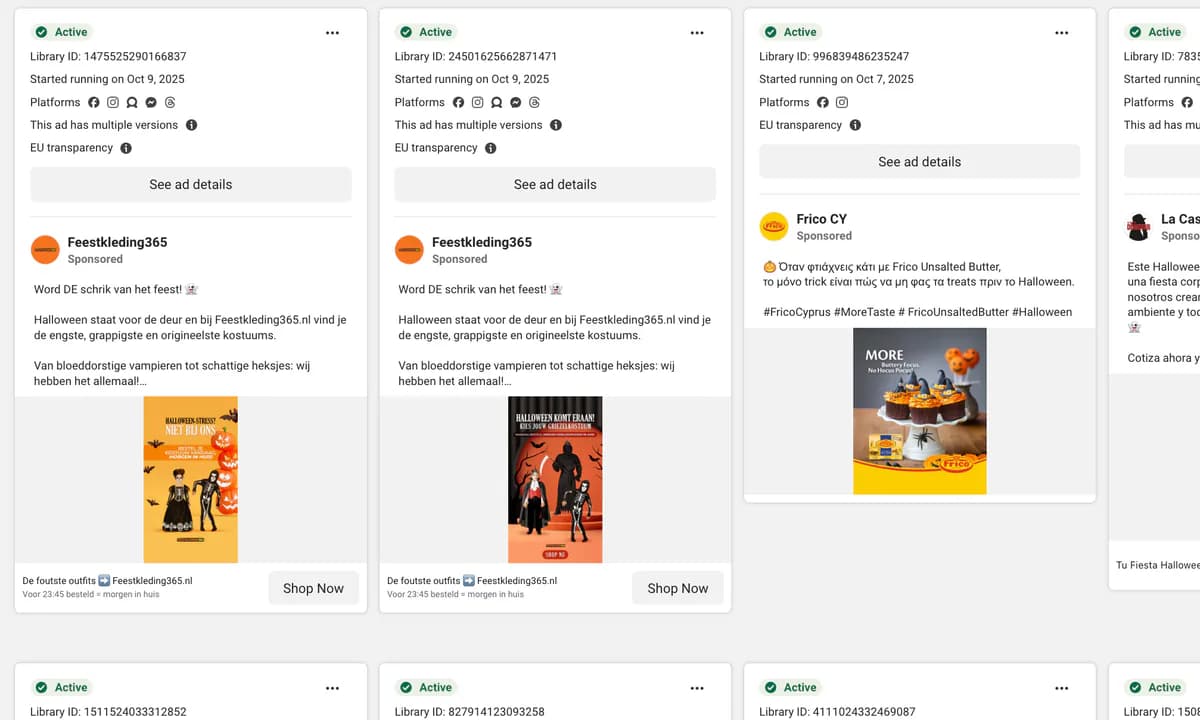
The Meta Ad Library is like reading footprints after the race. You don’t get CTR, CPA, MER, or ROAS—but you do get patterns. And patterns are enough to go from curiosity to cart if you read them the right way.
This playbook explains the proxy signals that serious operators use to infer performance and prioritize tests, then shows how to summarize everything in Insights so the whole team sees what to try next.
What you can and can’t know from the Library
- You can know: who’s active in your niche, which creatives are live, how often variants drop, which geos are targeted, how long specific ads keep running, and how offers/claims are framed.
- You can’t know: exact spend, CAC, ROAS, or conversion rate. That’s fine—proxy metrics exist for a reason.
- Golden rule: a single ad is a weak clue. A cluster of related ads over time is an evidence trail.
--------------------------
--------------------------
The five core proxy signals
- Longevity (L): If a creative runs 30–90 days with only light refresh (new cuts, minor copy edits), that suggests the unit economics are holding. Short bursts with no return often indicate “burn-and-churn” tests.
- Variation Velocity (V): How quickly does the advertiser ship new cuts? Healthy accounts tend to release small variants every 7–14 days, not entirely new concepts every 48 hours. Look for the ratio of micro-edits to big concepts.
- Geo Spread (G): Ads repeating across multiple countries or language clusters imply a scalable angle. A creative that survives translation is usually built on a strong promise, demo, or price frame.
- Offer Stability (O): If the offer architecture (anchor price, bundles, scarcity, testimonials) stays consistent across variants, it’s probably doing the heavy lifting. Watch the anchor itself—e.g., €59 → €49—and if comments improve afterward.
- Advertiser Density (D): More competitors running similar frames is a rising-tide signal. Yes, it’s noisier—but it also means audiences are primed. Use density to choose where to learn fast, not where to be alone.
A quick scoring rubric (0–5 each, total 25)
- Longevity: 0 = disappears in <7 days; 5 = persists 60–90 days with minor refresh.
- Variation Velocity: 0 = chaos/no thread; 5 = deliberate cadence with small wins compounding.
- Geo Spread: 0 = single geo only; 5 = 3+ geos or languages with similar framing.
- Offer Stability: 0 = weekly whiplash; 5 = consistent architecture with improving micro-metrics.
- Density: 0 = tumbleweeds; 5 = multiple serious players with recurring angles.
Interpreting the rubric (examples)
- Beauty serum UGC demo: L=4, V=4, G=3, O=5, D=4 → 20/25 (test now; bring testimonial + price anchor).
- Pet hair remover gadget: L=3, V=5, G=4, O=3, D=3 → 18/25 (test fast; iterate hooks; bundle 2-pack early).
- Nordic outdoor jacket: L=5, V=3, G=2, O=4, D=2 → 16/25 (strong longevity; focus on a single geo first).
Reading the page like an operator (not a tourist)
- Look at clusters, not singles: Find 8–12 ads that share the same promise/visual language. If the cluster keeps returning, you’ve found a working angle.
- Study first 3 seconds: Hooks that repeat across brands (“watch this spill…”, “peel and reveal…”) usually buy cheap attention and lift downstream CTR.
- Offer posture > exact words: “Buy 2, Save 20%” vs “3 for 2” vs “Starter/Family/Pro” tiers—different skins, same skeleton. If the skeleton repeats, the offer converts.
- Comment sentiment is a sanity check: Fewer “too pricey” comments after a price drop, or more “just ordered” after adding a bundle CTA, supports the proxy read.
--------------------------
--------------------------
Turning proxies into a test brief
Answer these before touching Ads Manager:
- Target geo(s): Where does this angle appear stable?
- Creative frames: UGC demo, polished explainer, hybrid? (Don’t pick one—pick two.)
- Offer: Anchor, bundle, scarcity. Which pattern did you see, and what’s your first swing?
- Objections: What did comments complain about? Address those on page and in captions.
- KPI staging: First we want thumb-stop and outbound CTR; then View-Content cost; then ATC/IC and CPA.
A 30-minute library-to-brief workflow
- 0:00–05:00 — Shortlist 3–4 brands in your niche with recent activity.
- 05:00–12:00 — Save 8–12 example ads across those brands; tag by hook/format/offer.
- 12:00–20:00 — Score each ad 0–5 on L, V, G, O, D; write a one-line verdict.
- 20:00–25:00 — Synthesize: which hook + offer combo keeps reappearing?
- 25:00–30:00 — Draft the creative/offer test brief and note your first two optimization levers.
Using Insights as the single source of truth
- Tags for everything: country, language, niche, hook (“demo”, “before/after”), format (“UGC”, “hybrid”, “polished”), and offer (“anchor49”, “bundle3pack”). Teams search; no one hunts.
- Save evidence, not folklore: screenshots, ad links, notes, and a one-line verdict (win/neutral/lose + why).
- One weekly summary: top hooks, price anchors that seem acceptable, and “do not test” ideas that keep failing.
- Shareable memos: Marketing, creative, and ops get the same picture—what we saw, what we’re testing, and what we’ll do next if CPA holds.
Common pitfalls (and how to avoid them)
- Survivorship bias: You only see what’s still live. Counter it by checking flight/rest cycles over weeks.
- Misreading seasonal spikes: Gifts and peak retail moments distort offer elasticity. Compare like-for-like weeks.
- Overfitting to one brand’s edge: If only one advertiser can pull it off (brand equity, influencer), don’t copy it blindly.
- Underestimating logistics: Library signals can’t fix slow shipping or messy returns. Price psychology collapses when trust is low.
Mini-comparison: UGC vs polished vs hybrid (by proxy signals)
- UGC: Often wins attention and authenticity; watch for high Variation Velocity and comment sentiment. Can struggle with complex explanations unless the demo is crystal clear.
- Polished: Strong for premium positioning and technical proof; watch Longevity and Offer Stability. Risk: expensively overproduced without a working hook.
- Hybrid: Scrappy open + polished explainer. Frequently travels better cross-geo. Look for Geo Spread and steady Offer Stability.
Sanity thresholds before scaling
- Hook repeatability: The same “aha” keeps working with small cuts.
- Offer resilience: Anchor/bundle holds CPA after 3–5 days of learning.
- Comment lift: Fewer price objections, more “ordered” signals after a tweak.
- Cross-geo echo: The angle repeats in at least one more market with minor localization.
--------------------------
--------------------------
FAQs
How many examples do I need before I trust a proxy read?
Around 20–30 ads across 3–4 brands is a strong start. Think clusters over time, not one-day snapshots.
Can I infer spend from duplicate ads?
No direct spend, but breadth of placements, persistent IDs, and steady variant cadence suggest ongoing budget.
Do proxies replace real performance data?
Never. Proxies get you to smarter tests faster. The ad account decides the truth; the Library helps you frame the bet.
Free Trial: How to Sign Up for Insights - Powered by Trampolin.ai
Start by creating your 14-day free trial account, pasting your first product URL, and saving examples with tags and notes. No credit card required. Sign up here: https://insights.trampolin.ai/auth/register. Have questions? See the FAQ. Compare plans on Pricing.