Meta Ad Fatigue Early Warning │ How to Spot Decline Patterns Before Your CPA Spikes
Why read this: You don’t lose money when a creative dies—you lose money when you notice it too late.
This operator’s guide shows how to spot creative decline before CPA spikes, set refresh cadence by evidence (not vibes), and log everything in Insights so your team knows what to rotate in next.
------------------------
------------------------
What Meta ad fatigue really is (and isn’t)
- Fatigue isn’t “a bad creative.” It’s a good creative that already harvested the easy wins.
- It shows up first as softness in top-of-funnel signals (thumb-stop, hook hold), then spreads to CTR, then CPA.
- It worsens with slow rotations, narrow hooks, and brittle offers that can’t be reframed.
Your early-warning dashboard (practical thresholds)
- Hook Rate decay: First-3s hold/thumb-stop down ~10–20% vs. previous 7-day baseline.
- Outbound CTR slip: –15% vs. last stable week at the same budget & geo mix.
- Variant decay: Each new cut of the same concept underperforms >10% within 48–72h.
- Frequency friction: Prospecting frequency >2.5 with flat spend and falling CTR signals exhaustion.
- Comment drift: Buying-intent comments vs. objections tilts negative.
Creative health vs. fatigue (quick comparison)
| Healthy | Fatiguing |
|---|---|
| CTR steady ±5% over 14 days | CTR slips 10–20% for 5–7 days |
| Micro-variants match/beat hero by day 3 | Micro-variants fail to catch up |
| Comments net-positive | Comments skew to price/trust objections |
| CPA stable after learning | CPA +10–25% WoW |
| Frequency 1.3–2.0 | Frequency >2.5 without new reach |
------------------------
------------------------
Refresh cadence by risk tier
- Tier A (scale creative): Pre-schedule 2–3 micro-variants/week (new hook line, first-3s crop, alt CTA). Replace the hero only when two consecutive micro-variants fail to recover CTR.
- Tier B (promising test): 1–2 micro-variants/week; pivot to a sibling concept after 10 days of flatness.
- Tier C (maintenance): Archive after 2 fails; repurpose for retargeting/UGC mashups.
Variant taxonomy that delays fatigue
- Hooks: problem/solution, “watch this,” before/after, social proof, price reveal, unboxing, live demo.
- Formats: UGC selfie, UGC studio, hybrid (UGC open + polished explainer), fully polished.
- Offers: anchor price, bundles, limited-time scarcity, free shipping threshold, guarantee emphasis.
- Visual levers: first-frame change, tighter crop, motion intro, caption style, colorway swap.
- Copy levers: reorder bullets, rotate proof, retitle CTA, localize by geo.
Patterns that predict the dip
- The two-step slide: Hook holds, CTR slips → next, hook slips too. Fix the premise, not just the edit.
- Variant cannibalization: Too many lookalikes split learning. Consolidate best two variants per ad set.
- Offer rust: If comments keep asking price/returns, your offer clarity leaks—not the edit.
- Geo mismatch: Winners can tire faster across markets if price frames/testimonials aren’t localized.
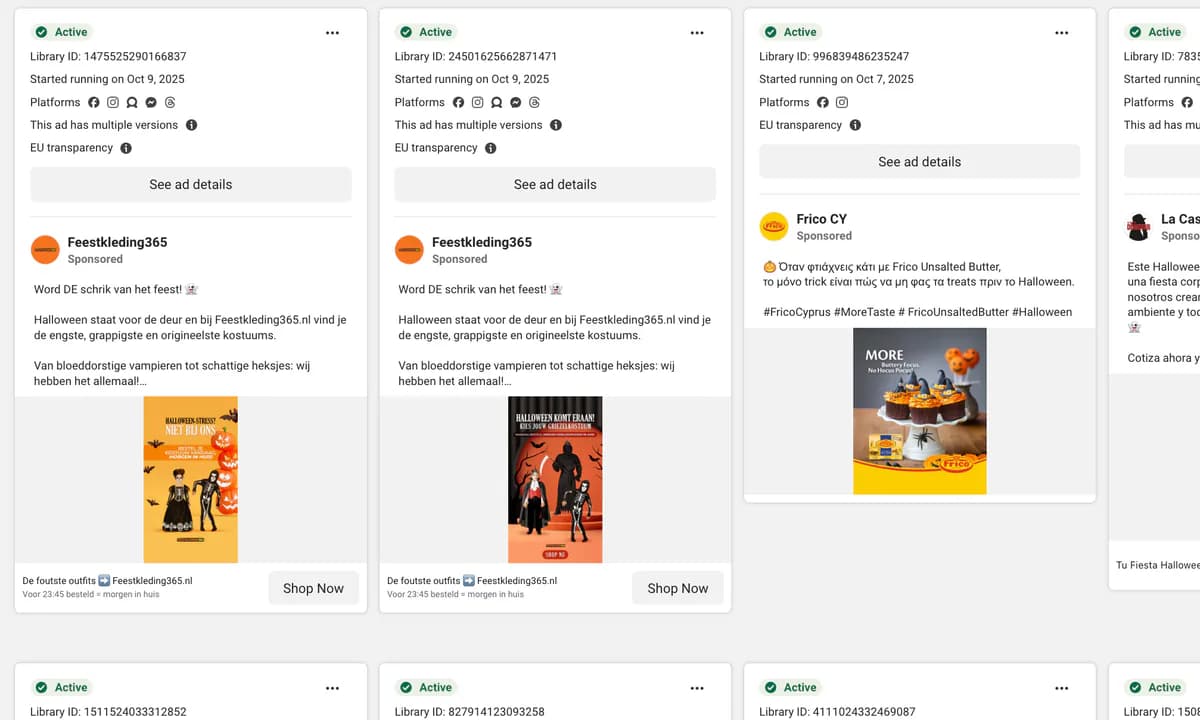
How the Meta Ad Library still helps (without ROAS)
- Longevity across 30–60 days
- Variation cadence (weekly micro-edits)
- Geo spread (new languages)
- Offer stability (anchors/bundles persist)
A 30-minute weekly fatigue audit (repeatable)
- 0:00–05 — shortlist actives; log 7-day CTR, hook, CPA, frequency, comment ratio.
- 05–15 — create two micro-variants; prep one sibling concept.
- 15–25 — check Library for competitor cadence & offers; steal the structure, not the words.
- 25–30 — publish rotation schedule & owners; archive 1–2 flats.
Playbook: 10 variations that usually buy time
- First-frame swap (motion intro or dramatic crop)
- New hook line (problem/solution or price surprise)
- Caption redesign (high-contrast)
- UGC duet (voiceover atop demo)
- Proof punch-in (strongest 3s up front)
- Offer restack (bundle/anchor at 4–6s)
- CTA reshuffle
- Audio/VO change
- Colorway/environment swap
- Geo-localized testimonial + subtitles
Evidence-first decision tree
- Hook ↓ & CTR ↓ → new premise + opening.
- Hook ↑ but CTR ↓ → fix the bridge (headline/caption clarity & landing match).
- CTR steady, CPA ↑ → offer/landing friction; test bundles/clarity.
- Frequency ↑, Reach flat → rotate audiences/cap; new angle after two failed micro-variants.
------------------------
------------------------
Team workflow inside Insights
- Tag by concept, hook, geo, offer pattern.
- One-line verdict per variant (win/neutral/lose + why).
- Weekly “Fatigue Watch” collection.
- Friday memo: what fatigued, what recovered, matched competitor cadence.
FAQs
How do I know I’m too early with a refresh?
If micro-variants consistently beat the hero, you weren’t early—you were smart. “Too early” is replacing a hero before two sustained soft signals.
What’s a safe test budget per new cut?
Enough for meaningful clicks in your niche. Aim for the same clicks the hero needed; scale only when CTR & comment ratio confirm.
What if every new cut underperforms?
Change the premise (what you say), not just the polish (how you say it). Switch from demo-first to problem-first, or from UGC to hybrid.
Free Trial: How to Sign Up for Insights - Powered by Trampolin.ai
Create your free 14-day trial account, paste your first product link, and start logging fatigue signals in one place. No credit card required.
Sign up: Free trial · More details: FAQ · Compare plans: Pricing