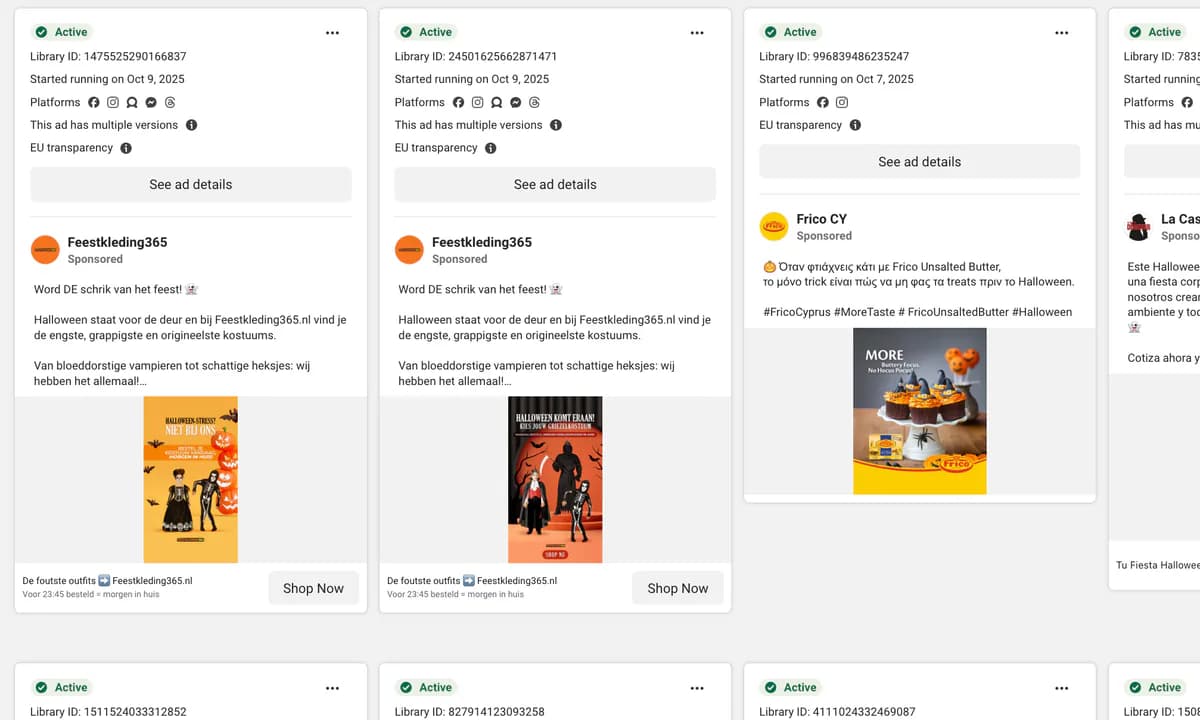
Meta Ad Library Data Now Collected in The Netherlands: Now You Can Validate Scaling and Winning Products in Holland
After enabling the two biggest e-commerce markets in Europe, Germany and Great Britain, Insights by Trampolin.ai is now taking another serious step forward: Meta Ad library data collection is now enabled in the Netherlands.
That means you can now use the Dutch market as a much stronger validation layer inside your workflow.
You can inspect products sold in Holland, analyze whether ad activity looks sustained, study how a seller is iterating its creatives, and make smarter calls on whether a product is worth your time, budget, and caffeine intake.
And let’s be honest. In e-commerce, “I have a feeling this might work” is often the opening line to a very expensive mistake.
The better play is this: find a product in a mature market, validate winning products with real market signals, then move quickly into countries where the same product is still underexploited.
With the Netherlands now added to the growing country coverage in Insights, that process becomes broader, faster, and more practical.
Why the Netherlands matters so much for product validation
The Dutch market is not just another pin on the map. It is one of the most mature e-commerce environments in Europe.
Recent market overviews describe the Netherlands as a highly connected, digitally advanced market with very high online shopping penetration, a large base of online shoppers, and strong cross-border buying behavior.
In plain English: Dutch consumers are very online, very used to buying online, and not easily impressed by sloppy offers.
That makes the Netherlands unusually valuable as a validation market.
When products sell in a mature e-commerce environment, that does not automatically mean they will work everywhere.
But it does give you something much more useful than random hype: evidence that demand may be real, creative execution may be dialed in, and the offer may already be surviving in a high-standard market.
The Netherlands also punches above its weight strategically. It is small enough to be practical, but important enough to reveal patterns that can travel.
A product that proves itself in Holland can become a smart candidate for adjacent markets, especially when you combine product validation with market-specific creative and ad generation in the local language.
So yes, this is a coverage update. But it is also a workflow upgrade.
What “Meta Ad library data collection in the Netherlands” actually unlocks
Let’s keep this grounded, shall we?
This update does not mean you press one magic button and a golden goose flies out of your dashboard carrying a seven-figure product in its beak.
Anyone who promises that should probably be banned from writing landing pages for a week.
What it does mean is much more useful.
- validate scaling products in a mature European market before committing more time and money
- inspect whether advertiser activity looks like a short test or something with staying power
- spot creative iteration, angle diversity, and consistency across a product’s ad presence
- use the Netherlands as a product discovery and validation layer for broader European expansion
- move faster from “interesting product” to “worth testing” with less guesswork
Insights is built around a practical idea: paste a supported URL, pull relevant signals, and judge faster whether a product deserves attention. Across plans, the platform states that it includes 90 days of history, and the trial currently includes 10 free insights over 14 days with no credit card required.
That matters because validation gets stronger when you can compare current momentum with recent history instead of reacting to one lonely ad spike and calling it destiny.
Why Holland is such a useful market for finding products that can travel
If you want to find scaling products in Europe, you do not just want volume. You want signal quality.
The Netherlands gives you several useful layers of signal quality at once.
First, Dutch e-commerce is mature. Consumers are experienced. Expectations are high. Payment infrastructure is strong. Delivery and returns matter. That means weak offers are more likely to get exposed quickly.
Second, Dutch consumers are comfortable buying cross-border. That is a big deal. A market with strong cross-border shopping behavior often becomes a useful proving ground for products with broader European potential.
Third, the Netherlands sits in a practical strategic position. It is deeply connected to broader European logistics and commerce flows, which makes it attractive not only for domestic sellers but also for operators thinking regionally from day one.
Fourth, local buying behavior is not identical to Germany or the UK. That is good news. If a product shows traction across different mature markets with different customer habits, you are usually looking at a stronger signal than a one-country wonder.
That is where the expanding country coverage inside Insights starts becoming genuinely powerful. You are not limited to one local bubble. You can compare, pressure-test, and validate more intelligently.
From bigger coverage to smarter workflows
This is the bigger story.
Adding the Netherlands is not just about one more country. It is about enlarging the playfield for product research, validation, and expansion.
Before, you might have discovered a product in one market and wondered whether it had legs elsewhere. Now the process becomes more robust:
- Find a product that looks interesting in one covered country.
- Check whether similar momentum appears in the Netherlands.
- Review the ad pattern, creative depth, and historical consistency.
- Decide whether the product deserves localized creative testing in another market.
- Use ad generation and product page generation in the relevant language to move faster.
That is a much better loop than the classic e-commerce method: see product, get excited, build store, launch ads, learn expensive lesson, pretend it was “brand research.”
A mature workflow is less romantic, but far more profitable.
Traditional product hunting vs a validation-first workflow
| Step | Traditional approach | Validation-first with Insights |
|---|---|---|
| Product discovery | Scroll social platforms and copy what looks hot | Start with products already showing ad activity and momentum |
| Demand validation | Launch ads and hope for the best | Read real signals before investing heavily |
| Market expansion | Guess where else it might work | Compare covered countries, including the Netherlands |
| Creative direction | Start from zero and improvise | Learn from existing creative angles and iteration patterns |
| Time to shortlist | Days or weeks | Minutes to hours |
| Cost of bad picks | Ad spend, setup time, creative costs | A few analyses and faster rejection |
This is where things get commercially interesting.
There are many products sold in the Netherlands that may be highly relevant for other European markets, especially where the same product category is growing but local competition is thinner or creative execution is weaker.
That does not mean copying blindly. It means observing intelligently.
You can look at a product performing in Holland and ask practical questions:
- Is the offer clear and easy to localize?
- Does the product solve a simple problem or create an obvious desire?
- Does the creative rely on universal hooks or very market-specific cultural cues?
- Would the pricing still make sense after shipping, taxes, and local expectations?
- Is the product early enough in another country to justify testing?
When you can answer those questions with actual market signals behind them, you are no longer just “chasing winners.” You are building a repeatable system to validate winning products before they become crowded everywhere.
What good product validation looks like in practice
A product is not interesting just because ads exist. Plenty of products have ads. Some of them are basically digital confetti with a budget.
When you validate scaling products properly, you are usually looking for combinations of signals rather than one isolated clue.
1. Consistency over time
Short bursts happen. Tests happen. Panic spending happens. Sustained activity is more useful than one dramatic spike.
2. Creative iteration
When a seller keeps testing angles, formats, hooks, or ad styles, that can indicate they are learning and reinvesting rather than casually tossing a product into the void.
3. Clear offer-market fit
A product should make sense for the market. In the Netherlands, that often means clear checkout expectations, reliable payment handling, practical delivery logic, and a store that does not look assembled during a lunch break.
4. Transfer potential
Some products work because they are universal. Some work because they are deeply local. The smart operator learns to tell the difference before building the campaign structure.
5. Operational sanity
Can the product be shipped reasonably? Returned without wrecking your margins? Supported without turning your inbox into a support horror film?
Those questions still matter. The data helps you validate demand. You still need to validate execution.
Comparison table: why Dutch validation can improve European expansion
| Dutch market signal | Why it matters | What you can do with it |
|---|---|---|
| Very mature e-commerce behavior | Signals are often less noisy and more commercially meaningful | Use Dutch traction as a stronger filter before testing elsewhere |
| High online shopping penetration | More buyers are already comfortable transacting online | Assess whether a product can survive in a demanding online market |
| Strong cross-border behavior | Products may have broader regional relevance | Identify offers with potential to travel across Europe |
| Efficient payment culture, including iDEAL familiarity | Checkout expectations are practical and trust-driven | Adapt payment messaging and conversion flow for local markets |
| Strong logistics position | Delivery expectations are real, not theoretical | Evaluate whether your operations can match the standard |
This is why the Netherlands is not just “another country added.” It is a strategically useful country added.
Why this matters for agencies, operators, and in-house e-commerce teams
Different users will benefit in different ways.
Agencies
Agencies need repeatable workflows, not lucky guesses dressed up as strategy. With broader country coverage, agencies can build better briefs, reduce dead-end testing, and show clients why a product or angle deserves attention.
Solo operators
If you are running lean, you cannot afford to test every shiny object that appears on your feed. A stronger validation workflow helps you reject bad ideas faster, which is one of the least glamorous and most profitable skills in e-commerce.
Brand owners and in-house teams
If you already sell online, the Netherlands can become a discovery layer and a benchmarking layer. You can evaluate how products are being framed, how ad angles evolve, and whether adjacent market expansion makes commercial sense.
bigger coverage means better context, better context means better decisions.
The compounding value of expanding country coverage
One of the easiest mistakes in product research is treating each market as an isolated event. In reality, the value compounds as coverage grows.
Germany gave you a major market. Great Britain gave you another major market. Now the Netherlands adds a mature, high-signal market with real strategic relevance.
Each added country improves not only discovery, but comparison. And comparison is where stronger conviction comes from.
A product that looks promising in one market is interesting. A product that shows compelling signals across multiple mature markets is much more serious.
That is why this update matters beyond Holland itself. It strengthens the whole logic of the platform.
And because Insights is not just about validation in a vacuum, but also about helping users move toward faster creative and product-page execution in multiple languages, the value of each new market multiplies. Find in one place, validate in another, adapt fast, launch smarter.
That is a very different game from guesswork.
A simple Netherlands-first validation workflow you can actually use
Here is a practical workflow you can steal immediately:
- Start with a shortlist of products already on your radar.
- Check whether any are being actively sold and advertised in the Netherlands.
- Review the ad pattern over time, not just the latest moment.
- Inspect whether there is creative variation and evidence of iteration.
- Evaluate whether the offer looks like it belongs in a mature market, not a short-lived gimmick zone.
- Decide where else the product could travel next.
- Localize the angle, creative, and product page instead of lazily cloning the original.
That final step matters. The goal is not to become a photocopier with a media buyer attached. The goal is to use validated signals to move faster with your own execution.
A quick reality check: data helps you move smarter, not lazier
It is worth saying this plainly.
Meta Ad library data collection helps you see more. It does not replace judgment. It sharpens it.
You still need to think about:
- margins
- fulfillment
- return friction
- compliance
- creative quality
- country-specific expectations
But the big win is this: you can now say “no” much faster to bad opportunities, and “yes” with more confidence to the better ones.
FAQ
Why is the Netherlands such a useful market for product validation?
Because it is one of Europe’s most mature e-commerce markets, with very high online shopping penetration, strong digital infrastructure, and meaningful cross-border buying behavior. That makes it a strong place to validate whether a product is showing real commercial promise.
Can I use Dutch data to find products for other European markets?
Yes. That is one of the practical advantages. You can use Dutch market signals to identify products that may travel well into other countries where the same offer is less saturated or less well executed.
Does this mean I can validate winning products faster?
Yes. The point of the workflow is to reduce guesswork, shorten the path from discovery to decision, and make it easier to validate scaling products before investing more heavily.
Where can I learn more about plans, testing, and setup?
You can review the readable version of the FAQ, compare the available Pricing, and try either the interactive demo or the Free Live Test depending on how hands-on you want to be before starting.
Free Trial: How to Sign Up for Insights - Powered by Trampolin.ai
To begin, go to the Signup page and create your account. Insights currently states that the trial runs for 14 days, includes 10 free insights, and requires no credit card to begin.
In other words, you can test the workflow without first entering a payment card and then wondering whether you just subscribed to another monthly regret.
A practical path is this: run the Free Live Test if you want a quick hands-on feel, then start the Free trial when you are ready to work inside the platform properly.
If you want plan details before making that decision, check the Pricing page. And if you want the nuts and bolts on how it works, supported flows, and common questions, the FAQ is the place to go.
The short version: the coverage is getting bigger, the workflow is getting smarter, and the barrier to testing it is very small. That is a good combination.