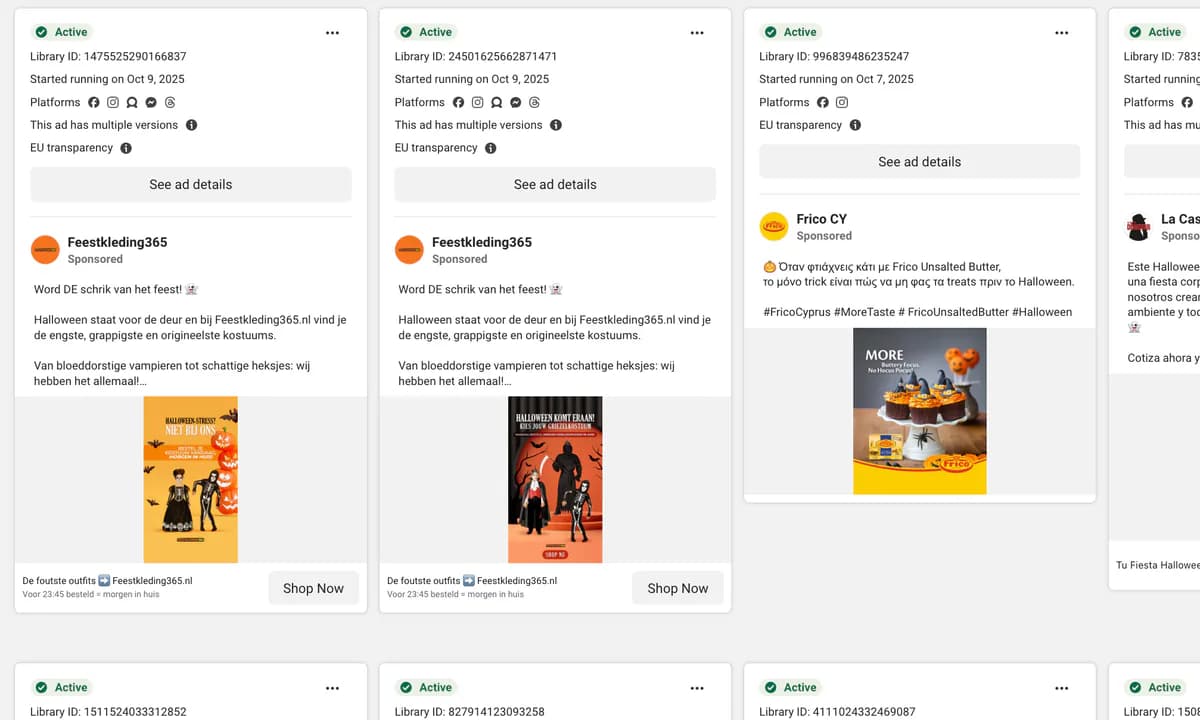
Micro-Trend Hunter: Catch 48-Hour Product Waves with Meta Ad Library + Insights
If “everyone’s suddenly selling it” has become a weekly surprise, you’re staring at micro trends—tiny, explosive waves that build and break in 24–48 hours. Blink and you’re late.
The good news: you can spot them quickly using visible signals in the Meta Ad Library, then log, tag, and act on them inside Insights before the crowd ships copycat ads.
This playbook teaches a pragmatic scan-and-pounce system built for ecommerce teams that need to find winning products fast. If you care about micro trends ecommerce, Meta Ad Library trend detection, and how to find winning products fast, this guide is your cheat code.
What exactly is a micro trend?
A micro trend is a short, intense wave of demand where ad activity clusters hard in a tiny window. You’ll see:
- Ad start density: multiple Pages start ads for the same product or problem within hours.
- Creative velocity: one or two Pages ship many small variants rapidly (hooks, crops, captions).
- Copy convergence: headlines start to echo the same promise or benefit.
- Domain clustering: multiple destination URLs selling materially similar items.
- Geo tilt: the first traction appears in one market, then spills regionally within a day.
These are Meta Ad Library trend detection clues. You won’t see CTR/ROAS in the Library, so you rely on external proxies that still correlate with lift: starts, variants, and spread. The payoff: spot momentum and find winning products fast before CPCs climb and margins thin.
-----------------------
-----------------------
Heuristics & thresholds (so you’re not guessing)
These are practical ranges—not laws of physics—derived from observed patterns across categories. Use them to prioritize speed without gambling.
- Start density: 3–5 new Pages in 24h = Watch; 6–10 = Test now; 10+ = You’re late unless you localize into a spillover market.
- Creative velocity: 8–20 near-duplicate variants from the same Page in 48h = someone is actively hunting novelty and getting signal.
- Copy convergence: when 3+ Pages use the same benefit phrase with minor edits, assume the message is doing the heavy lifting.
- Geo spread: first starts in DE/NL then SE/FI 12–24h later? Treat the Nordics as your fast-follow window.
- Half-life: expect many micro waves to fade in 3–7 days. Bank returns in the front 48 hours and recycle winning hooks into the next angle.
The 10-minute daily scan (repeatable routine)
The goal is to prevent analysis paralysis. Ten minutes, once or twice a day, on a tight loop.
- Pick a lane (2 min). Filter to your category keywords and likely problem phrases. Keep a short rotation (e.g., “pet hair remover”, “magnetic charging”, “anti-snore”).
- Check fresh starts (3 min). Sort by recently started. Note products with 3–5 new Pages in the last 12–24 hours.
- Scan creative velocity (2 min). Open Pages that launched multiple near-duplicates (colorway swap, hook swap, crop). Velocity means test budget is landing.
- Look for copy convergence (2 min). Are different advertisers repeating the same benefit line? Convergence = audience resonance.
- Log candidates in Insights (1 min). Capture ad links, product name, and a one-line why (“start density + geo tilt DE”). Tag with Microtrend, Hook, Variant-Burst. This is the backbone of the Insights microtrend workflow.
Pro tip: set a strict timer. The objective is throughput—a quick shortlist to validate, not a documentary.
Signals that matter (and what to do about each)
| Signal | What it means | First action | If confirmed |
|---|---|---|---|
| 3–5 new Pages start ads for the same item in 24h | Attention is concentrating | Save examples, tag Start-Cluster | Spin a one-asset test (1–2 hooks) |
| One Page ships 8–20 tiny variants in 48h | Budget is exploring novelty | Mirror the best hook shape | Add your own colorway/crop |
| Copy lines converge around 1–2 benefits | A message/angle is sticking | Rephrase the same promise with specifics | Create a stronger before/after |
| Geo tilt (e.g., DE → SE within 24h) | Regional lift, cheaper early clicks | Test in the first spillover market | Localize price/units early |
| Domain clustering across new stores | Dropship wave forming | Speed beats perfect brand | Get a clean PDP up within hours |
These lightweight proxies get you 80% of the way. Your job is to confirm fast and scale for the short window.
-----------------------
-----------------------
The 30-minute validation tree (don’t overthink it)
- Product reality check (5 min). Is it shippable, compliant, and not a support nightmare? If “maybe,” keep it in “Watch.”
- Supplier & margin snap (10 min). Two sources, gross margin > 55% at test price, stock for 14 days.
- Landing page spin (10 min). One clean hero image, one short demo GIF, social proof block, returns line, and delivery window.
- Creative starter (5 min). Two hooks: problem → aha; proof number → benefit. One thumbnail with the result image.
If any box fails hard, park it. Micro trends reward speed and discipline.
Hook shapes that travel (write them in 60 seconds)
- Problem → aha: “Pet hair everywhere? Watch this 5-second swipe.”
- Number-first proof: “Cuts prep time by 73% (home test).”
- Visual promise: a 1-frame before/after that makes the result obvious.
- Social proof mini: “10,000+ five-star orders in EU last month.” (Use a real number once verified.)
- Risk reversal: “30-day risk-free—if it’s not faster, return it.”
Write the headline after the hook. Keep the first 7–10 words specific; vagueness kills micro-trend momentum.
Creative velocity by vertical (what “fast” looks like)
- Beauty & personal care: frequent colorway/caption swaps; best hooks show immediate texture/result. 12–20 variants in 48h is common in waves.
- Home & kitchen: demo-first crops; two camera angles + before/after wipe. 8–12 variants in 48h.
- Fitness: benefit-led hooks with a rep counter overlay; add subtitle packs for silent autoplay. 10–16 variants in 48h.
- Gadgets: show the outcome, then the mechanism; swap background environments to refresh novelty. 12–18 variants in 48h.
The 48-hour sprint (hour by hour)
Hour 0–2: Save & set. In Insights, create a list named “Micro-Trend Hunter – {Week}”. Save 8–12 Library examples. Tag each card with Start-Cluster, Hook (short summary), and Geo.
Hour 2–6: Ship v1. Launch 2–3 hooks × 2 crops (1:1 and 4:5). Keep one control headline and change only the opening line per variant.
Hour 6–12: Cull. Kill the bottom half using early platform quality metrics (thumb-stop, clicks to LP). Keep the leader plus one challenger.
Hour 12–24: Localize. If you see a geo tilt, duplicate into the spillover market with currency and unit localization (ml vs oz, EU sizing).
Hour 24–36: Extend novelty. Add one colorway swap and a captions-with-subtitles version.
Hour 36–48: Ladder up. If ROAS holds in the platform and Library activity stays hot, add budget 20–30%, expand placements (Reels/Stories), and guard margin.
Validation worksheet (quick math you can do on a napkin)
- Target CPA = (AOV × target gross margin) × acceptable CAC share.
- Test budget = 5–7 × Target CPA per leading variant (enough to be wrong fast).
- Break-even click target = Target CPA ÷ expected CVR. If your early CPC makes this impossible, kill or change hook.
Landing page for burst windows (keep it frictionless)
- Single-screen story: hero, proof, delivery, risk reversal.
- Clarity > cleverness: don’t hide the punchline below the fold.
- Show the result image above the price.
- Add a one-line EU delivery expectation if you have it (e.g., ships from EU in 24–48h).
- Keep forms short; every field costs time during a micro wave.
Scaling & sunset (know when to press and when to leave)
- Press when the Library shows fresh starts + your CTR and CVR stabilize. Expand placements and light retargeting.
- Hedge when leaders hit v30+ variants and your CPC lifts. Save hooks for the next angle and collect emails for remarketing.
- Sunset when the wave is fully crowded and novelty is gone; recycle your best proof as a UGC testimonial in the next test.
-----------------------
-----------------------
Team workflow inside Insights (so nothing gets lost)
- Save the Meta Ad Library link and a short title (“Magnetic Mug – start cluster”).
- Tag with Start-Cluster, Creative-Velocity, Copy-Convergence, Geo-Tilt as applicable.
- Paste supplier notes and a one-line margin calc.
- Attach your v1 creatives and thumbnails.
- Add outcomes and next steps (“SE localized, test 2 hooks tomorrow”).
This keeps ops, creatives, and buyers aligned while trends are moving fast. When you’re ready to compare plans, check Pricing; and if you’re wondering about specifics, the FAQ covers the details.
FAQ
How do I avoid chasing every shiny object?
Use a three-box gate: product reality, margin snap, landing page spin. If all three pass, you test. If any one fails hard, park it.
What’s the minimum creative I need to launch?
Two hooks × two crops, one thumbnail, and subtitles. That’s it. Iterate from there.
How many products should I track at once?
Three to five micro trends per week is realistic. The goal is fast confirmation, not a museum of maybes.
Can I ride the same wave twice?
Sometimes. If the Library shows a second start cluster a week later, treat it as new—fresh hooks, updated thumbnail, localized copy.
Free Trial: How to Sign Up for Insights - Powered by Trampolin.ai
Ready to hunt micro trends at speed? Start your 14-day free trial—no credit card required—create a “Micro-Trend Hunter” list, and track starts, variants, and outcomes in one place. When you’re ready to get moving, sign up and put the workflow to work.