New July, 2026 EU Tax: What Will It Mean For EU Based Dropshippers?
The European Union just did the thing every dropshipper “knew would happen one day” — and then promptly ignored because the CPMs were decent and the dopamine was flowing.
From 1 July 2026, small e-commerce consignments entering the EU with a value below €150 will be hit with a fixed €3 customs duty. And yes, this is directly tied to the EU’s plan to remove the famous €150 Duty-Free Exemption that made low-value parcels the internet’s favorite loophole.
If your EU business ships products from outside the EU (hello China), this is not “some boring customs thing.” It’s a per-order margin haircut that repeats… forever… on every single low-value order.
But here’s the good news: the people who win in 2026 won’t be the ones who complain the loudest. They’ll be the ones who tighten product selection, raise conversion, reduce wasted ad spend, and stop gambling on ‘maybe’ products.
Let’s break it down, shall we?
What exactly is changing in July 2026?
Starting July 1, 2026, the EU will apply a €3 Customs Duty to low-value e-commerce parcels entering the EU (typically consignments sent directly to consumers) when the intrinsic value is under €150.
A few crucial details (because customs always hides the pain in the details):
- The €3 is a customs duty, not VAT. VAT rules already exist (and yes, they already bite).
- It’s described as a fixed duty for low-value consignments as part of a transition to wider EU customs reforms.
- The charge is often discussed as “per parcel,” but in official language it can be applied per item in a consignment (depending on tariff headings). Translation: one package with two different items may not be treated as “one simple €3” in all scenarios.
This is why this is being called the New 2026 Duty for EU Based Dropshippers: it targets the exact flow most dropshipping models rely on — low-value, high-volume imports into the EU.
“Wait… weren’t low-value imports already taxed?”
Yes. Since the 2021 e-commerce VAT reforms, VAT applies to imported goods regardless of value. The old VAT exemption on tiny parcels is gone.
What stayed alive (until now) was the customs duty relief threshold: below €150, you generally didn’t pay customs duties (VAT still applied). Many businesses used the IOSS framework to make the VAT part smoother at checkout.
Now the EU is effectively saying: “Cool story. We’re adding a customs duty on top.”
So you get:
- VAT (still)
- Plus €3 Customs Duty (new from July 2026)
- Plus any carrier/admin costs that may be introduced or passed through
That’s why people are calling it the July 2026 EU Duty Tax even though it’s technically a customs duty.
Why is the EU doing this now?
Because the EU is drowning in parcels.
In 2024 alone, customs authorities processed billions of low-value packages, and a huge share came from outside the EU (with China as the main origin in many reports). The EU’s stated concerns include:
- Unfair competition for EU sellers
- Fraud and undervaluation risks
- Product safety and compliance issues
- Environmental impact of “ship everything everywhere all the time”
In plain English: the EU wants a system where low-value imports contribute something, and where enforcement isn’t funded by vibes.
What does the €3 duty actually mean for your dropshipping margins?
Let’s be brutally practical.
If you sell an item at €29.90 with a €12 landed cost and you normally clear, say, €10 gross margin after refunds/processing, that €3 is not “three euros.”
It’s:
- 30% of your gross margin (in many common dropship offers)
- The difference between profitable scaling and “I’m scaling my way into bankruptcy”
- A forced price increase or a forced efficiency upgrade
Quick reality check table: margin hit per order
| Example | Sell price | Product + shipping cost | Gross margin before €3 | Gross margin after €3 | Margin drop |
|---|---|---|---|---|---|
| Low-ticket gadget | €19.90 | €11.50 | €8.40 | €5.40 | -36% |
| Typical “winner” | €29.90 | €13.00 | €16.90 | €13.90 | -18% |
| Bundle/upsell order | €49.90 | €18.00 | €31.90 | €28.90 | -9% |
If your store is built on low AOV + high refund rates + “we’ll fix it in retargeting,” the math will feel personal.
Second-order effects: the sneaky costs nobody posts about
The €3 is the headline. The ripple effects are what break unprepared operators.
1) Price sensitivity goes up (especially on impulse buys)
Impulse buyers love €19.95. They don’t love “€22.95 because Brussels.”
You can pass on the cost — but you’ll need better positioning, better creative, and cleaner landing pages to maintain conversion.
2) Customer expectations get sharper
When customers pay more, they expect more. That means:
- Less tolerance for long delivery windows
- More questions about returns and duties
- More chargebacks if the experience is messy
3) Compliance becomes part of marketing
“Fast shipping,” “tracked,” “clear taxes,” “no surprise fees” becomes a conversion lever. If your store feels sketchy, this new duty makes it sketchier.
4) The “who pays it?” question gets messy
In practice, the cost can show up in different places depending on how you ship and what arrangements exist with carriers/platforms:
- The seller pays it and builds it into pricing (cleanest experience).
- The carrier collects it at import and invoices someone (often leading to delays).
- The customer gets asked to pay on delivery (highest-friction scenario).
For EU based dropshippers, the real risk isn’t the €3 itself — it’s the customer experience turning into: “Pay extra or we won’t deliver your package.” That’s refund city.
5) More admin, more checks, more variance
Higher parcel volumes have already pushed customs and carriers hard. Adding a new duty creates more touchpoints:
- More declarations and classification questions
- More edge cases (bundles, accessories, multi-SKU orders)
- More variation by route, carrier, and destination country
So yes, this is a Dropshipping Tax in Europe problem — but it’s also an operations problem.
How this interacts with VAT, IOSS, and the €150 threshold (in plain language)
If you’ve ever read a customs guide and thought “this was written by someone who hates humans,” you’re not alone. Here’s the simplest framing that stays accurate:
- VAT: applies to imports into the EU regardless of value (this has been the case since the 2021 reforms). VAT is about consumption tax and is usually collected at checkout (best) or at delivery (worst).
- IOSS (Import One-Stop Shop): a VAT simplification for distance sales of low-value goods (≤ €150) imported into the EU. It helps sellers collect VAT at checkout and declare it through a single portal instead of creating chaos at the border.
- Customs duties: historically, customs duty relief was available below €150 for many e-commerce consignments. That relief is being removed, and the EU is introducing a fixed €3 duty as a transitional measure from July 2026.
So if you are shipping low-value parcels from outside the EU to EU customers, you should plan for a world where:
- VAT remains a must-handle (preferably at checkout), and
- The new EU Duty adds a predictable extra cost per low-value shipment/item.
If you’re not using IOSS today and you’re still relying on “the customer will figure it out,” 2026 is going to feel like stepping on Lego — every day.
How EU-based dropshippers can mitigate the impact
You can’t “growth hack” customs. But you can out-execute it.
Here are practical plays that work — in the real world — without requiring you to become a customs lawyer.
1) Raise AOV so €3 hurts less
The higher your order value, the smaller the percentage hit.
Tactics:
- Bundles (2-pack, 3-pack)
- Order bumps (“add the accessory for €9.90”)
- Post-purchase upsells
- Tiered pricing (Basic / Better / Best)
AOV isn’t just a metric; it’s a duty shock absorber.
1.5) Adjust your offer math (not just your price)
A lazy response is “add €3 to the price.” A smarter response is to rethink the offer so the customer feels more value while you preserve margin.
Examples that often convert better than a blunt price hike:
- “Free tracked shipping + taxes handled” (clarity sells)
- “Bundle discount” (higher AOV without feeling like a tax)
- “Add-on included” (perceived value > cost)
If you do raise prices, test in small steps. In many EU markets, €1–€2 can be the difference between “impulse” and “I’ll think about it forever.”
2) Improve conversion so you pay less for every sale
If your conversion rate rises from 2.0% to 2.6%, your CPA can drop materially even at the same CPM/CTR environment. That gives you budget headroom to absorb the duty.
Where conversion usually improves fastest:
- Cleaner PDP structure (benefits > specs > proof > FAQ > guarantees)
- Faster page load
- Better offer clarity (shipping time, returns, taxes)
- Creative-message match (the ad promise matches the landing page reality)
3) Reduce refunds (because €3 + refunds = pain)
Refunds already kill margins. Now each refunded order also carried a duty hit and processing overhead.
Focus on:
- Better sizing/compatibility info
- More honest creatives (yes, really)
- Better product selection (see next point)
- Better supplier QC
4) Consider EU fulfillment for your real winners
If a product is a true scaler, shifting to EU-based stock can:
- Shorten delivery times
- Reduce surprise fees and friction
- Improve customer trust
It’s not always cheaper, but it can be more scalable.
5) Stop gambling on products — become data-driven with Insights by Trampolin.ai
This is the big one.
Most dropshippers don’t lose because customs fees exist. They lose because they spend thousands testing products that never deserved a cent.
In 2026, the margin for error gets smaller. So your testing needs to get smarter.
That’s where a tool like Insights powered by Trampolin.ai becomes less “nice to have” and more “why are you still guessing?”
Why the EU duty makes “product selection accuracy” worth real money
Let’s say you burn €3,000 testing three products:
- Product A: dead on arrival
- Product B: decent but not scalable
- Product C: finally works
You didn’t “test.” You paid tuition.
Now add a world where every low-value sale has €3 shaved off. You need your winners to be real winners — not “it broke even for 48 hours on broad.”
What “good testing” looks like when margins tighten
Good testing in 2026 is not “launch 10 products a week.” It’s:
- Launch fewer products,
- With clearer evidence they already sell,
- With creative angles that match real demand,
- And with faster kill criteria.
Insights by Trampolin.ai helps because it’s built for that workflow: paste a product URL, get a read on reach and trends, and decide if it’s worth your money.
And because it’s subscription-based with a trial, it’s not a big-bang investment. The platform offers a 14-day trial, includes free insights during the trial, and pricing scales by monthly insight volume. It’s designed so you can start small, then scale once your process is working.
What Insights by Trampolin.ai actually does (without the buzzword soup)
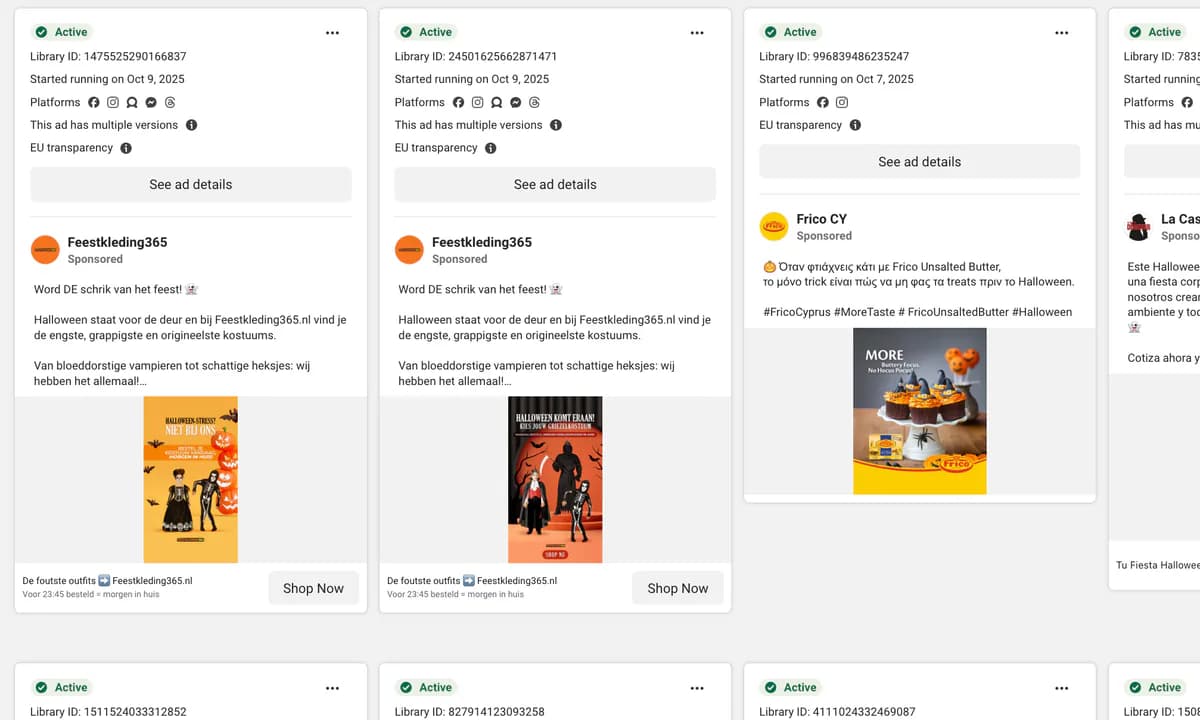
Insights is a competitive intelligence platform built around Meta (Facebook) Ads Library data, including reach signals, so you can see what products are getting pushed — and which ones show signs of real momentum.
In practical terms, you can:
- Paste a supported product URL and see the ads promoting it
- Spot whether a product looks like it’s scaling or stalling
- Benchmark creatives and angles that are already working
- Reduce wasted spend by focusing tests on products with real market signals
This matters because the cheapest way to “pay for the €3 duty” is not by arguing with customs.
It’s by not wasting €500–€5,000 on junk tests.
Comparison table: Guessing vs data-driven testing (2026 edition)
| Your workflow | What happens | Cost profile | How it feels |
|---|---|---|---|
| Gut-feel + trending videos | You launch fast… and often wrong | High creative spend + high test burn | Fun until the invoice |
| “Spy tools” with shallow signals | You copy what looks popular | Medium burn + medium misfires | Busy, not profitable |
| Data-driven with Insights | You test fewer, higher-probability winners | Lower burn + faster clarity | Boring… and that’s good |
In a world of tighter margins, boring wins.
What you should do now (a practical checklist)
Here’s your “2026-ready” checklist. No motivational quotes. Just moves.
- ✅ Audit your product mix: which offers rely on low-value impulse sales?
- ✅ Increase AOV: add bundles, bumps, upsells
- ✅ Tighten your refund drivers: expectations, delivery, QC
- ✅ Get your VAT/IOSS process clear (or stop pretending it doesn’t matter)
- ✅ Build a testing system that prioritizes proven market signals
- ✅ Expand into more EU + UK markets strategically instead of randomly
If you do only one thing: fix your testing. Your ad budget is the biggest controllable cost you have.
FAQs about the new EU duty (rewritten, practical versions)
1) Is this the end of the €150 Duty-Free Exemption?
The EU has agreed to remove the €150 customs duty relief for e-commerce imports as part of its broader customs reform. The July 2026 change introduces a transitional fixed duty on low-value parcels, which is designed to bridge the gap until a longer-term system is in place.
2) When does the €3 Customs Duty start?
The start date widely communicated is 1 July 2026. If you ship low-value parcels into the EU, plan for the change to affect pricing, compliance, and customer communication ahead of that date.
3) Does the €3 duty replace VAT?
No. VAT rules remain. VAT has applied to imports into the EU regardless of value since the 2021 changes. The €3 duty is a customs duty layered on top of existing VAT obligations.
4) Is the €3 duty per parcel or per item?
Many summaries describe it as “per parcel,” but official language indicates it can be applied per item in a consignment depending on how items are classified (tariff headings). If you sell bundles or multi-item orders, assume there may be scenarios where it is not a simple flat €3 per shipment.
5) Will marketplaces and platforms handle this for me?
Large marketplaces may implement collection and reporting mechanisms, but independent stores and direct-to-consumer dropshippers should not assume everything is “handled.” Your shipping method, carrier, and tax setup (including IOSS where relevant) can determine what the customer experiences at delivery.
6) Is there also a proposed handling fee?
Separate from the €3 duty, the EU has discussed additional handling fees for parcels in connection with customs checks and enforcement. These proposals have been widely reported, but you should treat them as separate from the confirmed €3 duty and monitor updates through official EU sources and your logistics partners.
7) What can dropshippers do to protect margins in 2026?
The highest-impact levers are: increase AOV, raise conversion rate, reduce refunds/chargebacks, and improve product selection accuracy. Many sellers also evaluate EU-based fulfillment for proven winners to improve delivery times and customer trust.
-------------------------------
-------------------------------
Free Trial: How to Sign Up for Insights - Powered by Trampolin.ai
If you want to offset the margin hit by wasting less ad spend and testing fewer “maybe” products, start with the system — not the next TikTok trend.
Start by creating your account on the Signup page: sign up here. You’ll instantly unlock the 14-day free trial (still no credit card required): start your free trial.
Once you’re in, paste a product URL and run your first analysis. In under a minute you’ll usually know whether the offer looks like a real winner or a slow-motion money fire.
If you want to explore before you commit, try the interactive Live Demo and run a Free Live Test. When you’re ready to scale, review Pricing and skim the FAQ for the practical details.