Reviving Meta Ad Fatigued Winners: Minimal-Change Playbook Backed by Library Evidence
If your once-mighty Meta ad suddenly feels like a dad joke at a teenage party, it’s not you—it’s fatigue. Winners fade. Audiences scroll past what they’ve already seen.
The fix isn’t always a full reshoot; often it’s a set of minimal changes that restore novelty without breaking brand or budget.
This playbook shows you how to revive fatigued winners with micro edits, using evidence you can see in the Meta Ad Library and a tidy workflow inside Insights so your wins don’t get lost in chat threads.
What “fatigue” looks like (even without CTR/ROAS in the Library)
- Creative lifespan: a great hook keeps showing up for weeks; sudden disappearance is a yellow flag.
- Variant density: when a Page starts shipping many tiny variants of the same core asset, they’re chasing novelty.
- Geo spread & format mix: a message that shrinks to one format/one market after being broad is likely past its peak.
- Comments & copy shifts: repeated objections and a move from bold claims to promotional band-aids can signal weakness.
Use these visible clues as your early-warning radar. Then run quick, controlled edits that spike novelty while keeping message-market fit intact.
--------------------------
--------------------------
The Minimal-Change Revival Ladder
Work down this ladder from fastest/lowest risk to higher-effort tweaks. Stop as soon as performance stabilizes.
1) Hook swap (first 1–2 seconds)
Replace your opener frame only: new promise, social proof, or pattern-break shot. Keep mid-section and end-card untouched. Good patterns: “problem → aha” cold open, bold number, before/after teaser.
2) Captioning & copy micro-swaps
Add burned-in subtitles; front-load benefit words in the first 7–10 words. Swap a single phrase: “Save time” → “Finish in 5 minutes”; “Premium” → specific proof (“A-grade steel”).
3) Colorway and background
Change border color, background texture, or card color. Keep product and pacing. Rotate light/dark, or shift accent to contrast your brand palette. Novelty without reshoot.
4) End-card micro-edits
New CTA verb (“Get yours” → “Try it today”), swap one proof icon (e.g., warranty/returns), or add a tiny urgency line (“Ships in 24h”).
5) Format & crop swap
Re-cut to 4:5 or 9:16; change crop to center hands/faces earlier; keep audio intact. Vertical reframes often feel “new” to Reels/Stories inventory.
6) Pacing & trim
Remove slow beats, add a 0.2–0.4s cut at the hook, or compress dead air. Aim for one idea per second for the first 3 seconds.
7) Thumbnail & first-frame still
Swap to a clear product-in-action still; add a headline sticker only. Thumbs are free reach: treat them like micro-ads.
8) Voiceover vs text-only
If your winner is VO-heavy, test text-only with music; if text-only, layer a friendly VO. Keep script identical; you’re testing delivery, not message.
9) Offer micro-tweak (no price cut)
Reframe value: “Free returns” → “30-day risk-free”; “Free shipping” → threshold shipping (“Free over €50”).
10) Rotation cadence
Introduce a 2-on/2-off schedule for the creative; use backups in between to reset attention.
--------------------------
--------------------------
Evidence from the Library: patterns that often precede a sunset
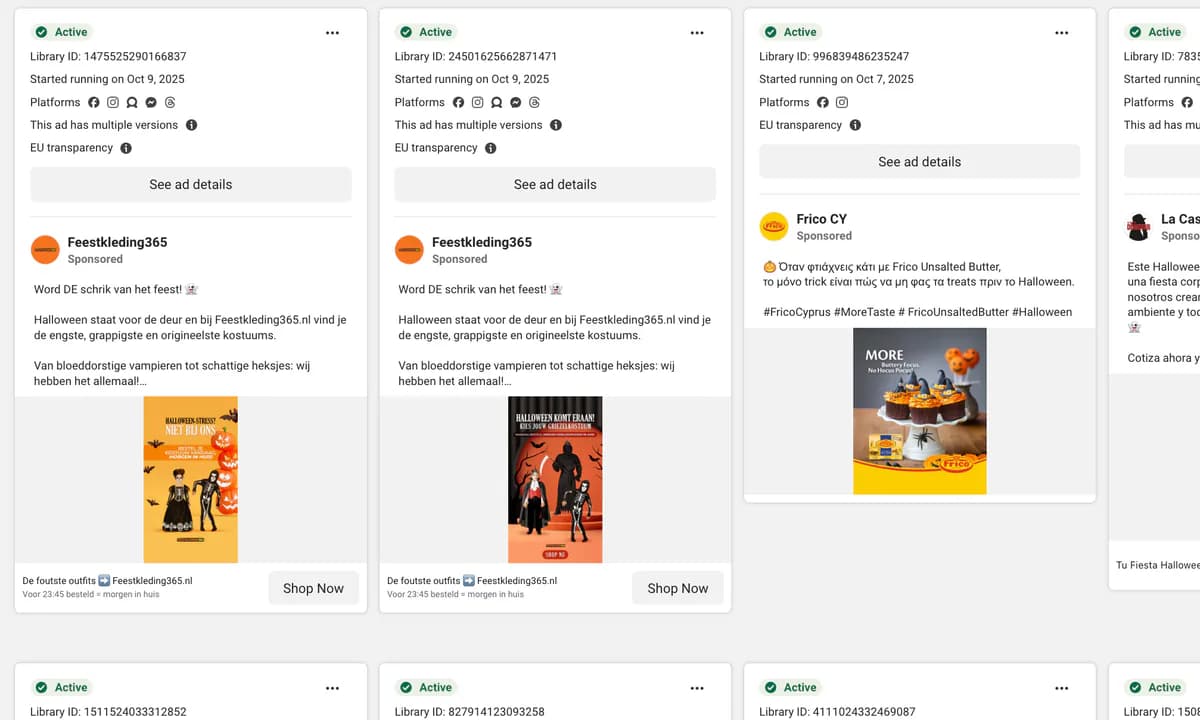
- Micro-variant drip: leaders clone a winner 10–30 times with tiny hook/color swaps—seeking novelty without a reshoot.
- Format shift: as performance slips, winners jump from 1:1 to 4:5/9:16 to access fresher, cheaper inventory.
- End-card refresh: logos and CTA wording rotate while core footage stays intact—classic minimal-change play.
Treat these as diagnostic breadcrumbs—use them to choose the next rung on the ladder.
Quick-compare: change vs effort vs risk vs when to use
| Change | Effort | Risk | Use When |
|---|---|---|---|
| Hook swap | Low | Low | Scroll-through rises; first 2 seconds feel stale |
| Captioning micro-swap | Low | Low | People watch muted; message lacks specificity |
| Colorway/background | Low | Low | Creative “feels samey” across placements |
| End-card micro-edit | Low | Low | Proof is buried; CTA sounds tired |
| Format/crop swap | Med | Low | Need novelty for new placements (Reels/Stories) |
| Pacing/trim | Med | Med | Video sags mid-way; too many “breathing” shots |
| Thumbnail/first-frame | Low | Low | Good watch-time, weak initial stop rate |
| VO vs text-only | Med | Med | Message works; delivery format fatigues |
| Offer micro-tweak | Med | Med | Value unclear; protect price integrity |
| Rotation cadence | Low | Low | Winner works again after short rests |
7-day resurrection sprint (hands-on)
Day 1 – Diagnose: In Meta Ad Library, pull your Page and leaders in your niche. Note hook phrasing, first frames, format mix, and end-card lines. Save 10–15 strong examples to an Insights list called “Fatigue Rehab.”
Day 2 – Prep: Create 4 micro variants (hook swap, caption tweak, colorway, end-card). Keep the mid-section intact.
Day 3 – Launch: Duplicate your best ad set. Run each micro variant at small, even budgets. Standardize audiences so you’re testing creative, not targeting.
Day 4 – Trim: Kill bottom 50% based on early proxies (thumb-stop/quality metrics in-platform; Library presence for peers).
Day 5 – Double-Down: Duplicate the top variant with one more change (e.g., crop to 4:5).
Day 6 – Refresh: Rotate the original winner back in for 48 hours alongside the leading micro variant.
Day 7 – Log & Decide: Document what worked in Insights—attach ad links, upload assets, and tag outcomes (Hook, Captions, Colorway, End-card, Format).
--------------------------
--------------------------
Micro-test rules (so you don’t confuse yourself)
- One variable at a time: a hook swap + color change = two tests; split them.
- Give each a fair window: 48–72 hours is enough to kill or keep.
- Name like a scientist: “w1_hook-benefit_v2_blue-border_4x5”. Your future self will thank you.
- Keep the control live: always run the original winner at a trickle to measure relative lift.
Messaging refresh: 10 copy lines that age well
- Proof-first: lead with a quantified outcome (“Finish in 5 minutes”).
- Specific scarcity: one clear constraint (“Ships today, limited color run”).
- Risk reversal: short, visible line (“30-day risk-free”).
- How it works in one step: micro demo script.
- Before/after in one sentence: show the delta.
- Material/ingredient flex: concrete inputs beat adjectives.
- Customer verbatim (shortened): keep it real, not fluffy.
- Time to value: the when is as powerful as the what.
- Who it’s for (and not for): repel the wrong clickers.
- Objection preemption: price, durability, compatibility—answer fast.
Pitfalls to dodge
- Full rebuild bias: a new shoot sounds exciting; micro changes are faster and often enough.
- Offer panic: cutting price too early trains deal seekers; fix value communication first.
- Over-testing: 15 near-identical variants cannibalize each other. Start with 4 and iterate.
Keep it all in one place (Insights workflow)
Create a list per product or campaign inside Insights. Save Library examples, paste ad links, attach files, and record outcomes in the same card. Use tags like Hook, Caption, Colorway, End-card, Format so anyone on your team can filter wins and replicate them next week.
Free Trial: How to Sign Up for Insights - Powered by Trampolin.ai
Ready to rescue your fading winners? Start your 14-day free trial—no credit card required—create a “Fatigue Rehab” list, and track hooks, captions, colorways, and outcomes in one place. When you’re weighing plans, visit Pricing; need details? see the FAQ; and when you’re ready to get moving, sign up.