How To Stop Burning Your Meta Ad Budget
Europes e-commerce scene is sharp, but even veteran teams watch Meta budgets evaporate in “learning limited” limbo. If that sounds familiar, this guide is your caffeine shot: a practical way to stop waste at the source using Insights — Powered by Trampolin.ai. You’ll learn a fast, repeatable workflow for product validation, higher Ad Creative Conversion, and smarter scaling rooted in the Meta Ad Library and real Shopify signals.
Why budgets burn on Meta (and how to put out the fire)
Most accounts bleed from the same handful of issues, and each one is fixable with structure rather than luck.
- Weak hooks and generic messaging. You’re talking features while the customer is scrolling for a feeling.
- Creative fatigue. The same ad runs too long; performance droops as frequency climbs.
- Offer–audience mismatch. Great product, wrong promise or price positioning.
- Landing-page friction. Slow, confusing, or misaligned pages break intent.
- Chaotic testing. Too many variables change at once, so you can’t learn what actually moved the needle.
Industry experience and common analyses agree: non-converting ads usually stem from mismatched creative or measurement, not mysterious algorithms. The fix is a tighter research loop and cleaner test design.
------------------------
------------------------
Meet Insights: your decision radar
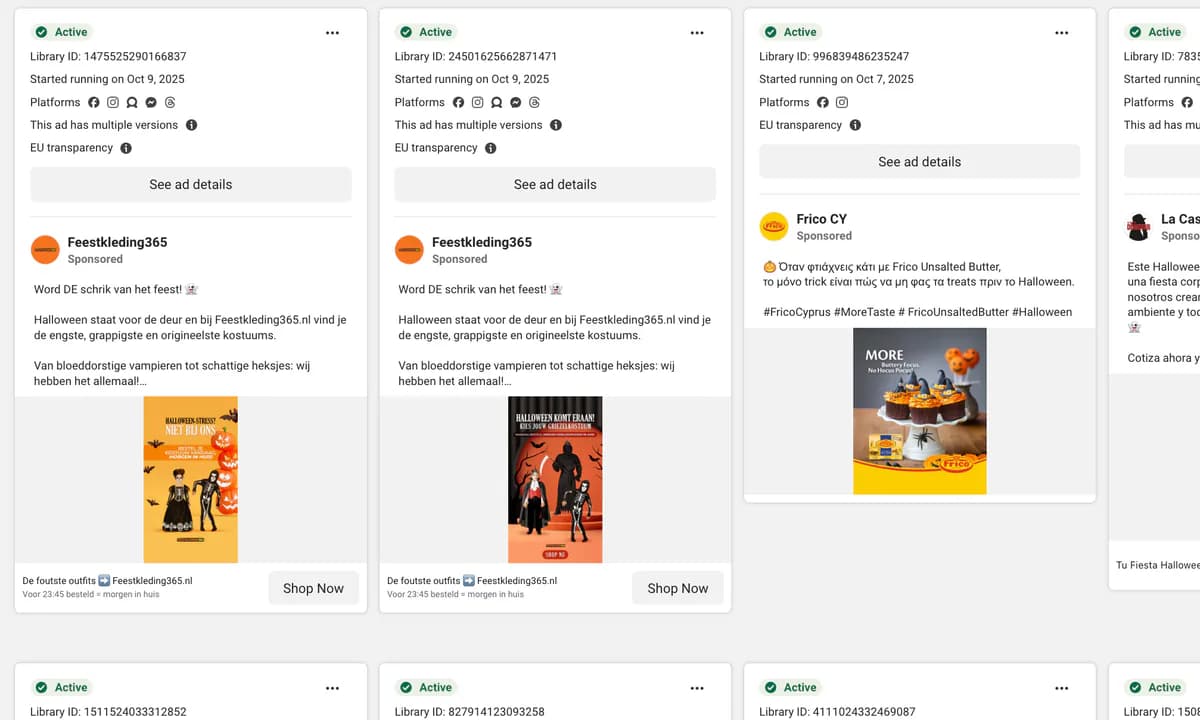
Insights blends what you can see in the Meta Ad Library with store-level context from Shopify to answer two money questions fast. Is the product worth a test, and what creative structure is most likely to work?
What you’ll actually use
- URL drop-ins. Paste a product link and see related ads, active stores, and category heat — no tab spaghetti.
- Creative patterning. Spot dominant hooks and formats (UGC demo, transformation, problem→solution, price anchoring).
- Fatigue detection. Track repetition and cadence so you refresh before performance decays.
- Competitor reality. Benchmark real stores and publishing frequency instead of guessing from a few screenshots.
- From pattern to production. Turn signals into briefs so you Create Ad Creatives with proof, pacing, and clarity.
The payoff is simple: fewer bad tests and more good ones — which is the purest form of Value for Money.
Signals that predict success (before conversions mature)
Don’t wait for perfect attribution; read leading indicators in the first 48–72 hours. If people won’t pause or click, creative is the problem; if they click but don’t buy, fix the offer or landing page.
- Thumb-stop rate and first-second hold: diagnose attention.
- CTR (outbound) and unique link clicks: prove curiosity.
- Comment quality: “How much?” or “Where do I buy?” beats generic emojis.
- CPC trend: stable or down suggests the angle resonates.
- Frequency vs. CTR: rising frequency with falling CTR screams creative fatigue.
Use Insights to see how winners open, what they promise first, and how quickly they reveal the outcome — copy the structure, not the pixels.
A clean testing architecture (so learning actually happens)
Most waste comes from chaotic testing; structure turns chaos into learnings you can scale.
- One variable per test. Change the hook or the offer or the landing promise — not all three.
- Tight creative set. Two distinct concepts beat eight cosmetic tweaks.
- Aligned landing page. Mirror the ad headline; repeat the promise above the fold; show proof near the CTA.
- Time-boxed reads. Pre-commit thresholds for kill/keep/scale.
- Change log. Track what changed and why, so you don’t re-test old mistakes.
Pro tip: Use Insights to tag three winning angles in your niche and pick one to mirror — this beats “winging it.”
Creative frameworks you can adapt today
Frameworks reduce guesswork and increase your hit rate; here are five that travel well across categories.
- Problem → Outcome → Proof. Lead with pain, flash the transformation, back it with a quick testimonial.
- Myth-bust. “You don’t need X; you need Y.” Great for devices, supplements, and gadgets.
- Speed run. 5–7 jump-cuts to show the job done faster; perfect for convenience products.
- Comparison (no names). Frame benefits against “the usual way.”
- Social proof carousel. Real UGC clips with one-line overlays; avoid stock, favor messy-real.
Write briefs that specify the hook, the outcome shot, and one sentence of proof, then let editors own pacing.
Product and offer truth serum
Even elite creative can’t rescue a product nobody wants; triage ideas before you spend.
- Crowding check in the Meta Ad Library. If five big stores ramp at once, margins may compress.
- Positioning reality. Winners often cluster around premium, convenience, or novelty — match your angle to the pattern.
- Offer vs. AOV fit. Bundles, free shipping thresholds, or trials can raise take-rate without a margin meltdown.
- Operational promise. “Ships today” means you actually ship today.
The week-one plan (steal this)
Execute a simple Monday-to-Friday cadence to learn fast without torching budget.
Monday: shortlist 3 product URLs inside Insights; scan competitors and top creatives.
Tuesday: draft two concepts and one clear offer; storyboard the opening 3 seconds.
Wednesday: build landing copy that repeats the ad promise and adds proof.
Thursday: launch; annotate spend, CTR, thumb-stop rate, and notable comments.
Friday: kill one, iterate one, scale one; line up a fresh angle to stay ahead of fatigue.
Case-style math you can explain to finance (illustrative)
Small improvements compound quickly when you stop funding bad tests. If you typically burn €400/month on early tests, a **20–30%** hit-rate lift can reclaim €80–€120 each cycle. Over a quarter, the savings alone can outpace the subscription — with better learning on top. That’s real Value for Money.
Common pitfalls (and how to dodge them)
Most misses rhyme; avoid these and your odds improve immediately.
- Copying a stale winner. If a format saturates feeds, audiences are numb — remix the angle.
- Confusing offers. “Up to 27% if you buy three by midnight” isn’t an offer; make it simple and specific.
- Landing-page whiplash. Ad promises X, page talks about Y — mirror the headline and proof.
- Data FOMO. Don’t pivot on five clicks; wait for meaningful impressions.
- Endless micro-tweaks. When the concept is wrong, new captions won’t save it.
Responsible scaling without regret
Scale what works without waking the budget gremlins.
- Hold your angle steady. Increase budget gradually while maintaining structure.
- Add a fresh variant weekly. Stay ahead of fatigue with planned refreshes.
- Guard the landing experience. Speed, clarity, proof.
- Keep a change log. Preserve context so future tests stay clean.
------------------------
------------------------
Resources and next steps
See plans, answers, or a hands-on walkthrough here (one link each, used sparingly).
FAQ (quick hitters)
How is Insights different from scrolling the Meta Ad Library manually?
Manual browsing is scattered and slow; Insights adds structure, store-level context, and fatigue signals. You make decisions instead of collecting screenshots.
Will this replace creative testing?
No tool replaces testing; Insights reduces bad tests and raises the odds of good ones.
I’m new to Meta ads — will I get value?
Yes — start with URL drop-ins, mirror a proven structure, and keep variables tight. The tool helps you see what to copy (responsibly) and what to avoid.
Does Insights require a specific stack?
No — it’s stack-agnostic. Use any editor and Ads Manager; the value is faster discovery and clearer briefs.
Free Trial: How to Sign Up for Insights - Powered by Trampolin.ai
Get started in minutes — no credit card required. Create your account on the Signup page, paste a product URL, and run your first analysis. Use the findings to shortlist two angles, build two concepts, and ship a controlled test this week.